
University Library visit, Part 2
On our second visit to the UL, we looked at some scientific and literary manuscripts from the Islamic world. Yasmin Faghihi, Head of Near Eastern Collections at the UL, brought down a few of the manuscript treasures I selected for our workshop. We were joined by Kristine Rose-Beers, Head of Conservation, who gave us some wonderful insights into the materiality of books.
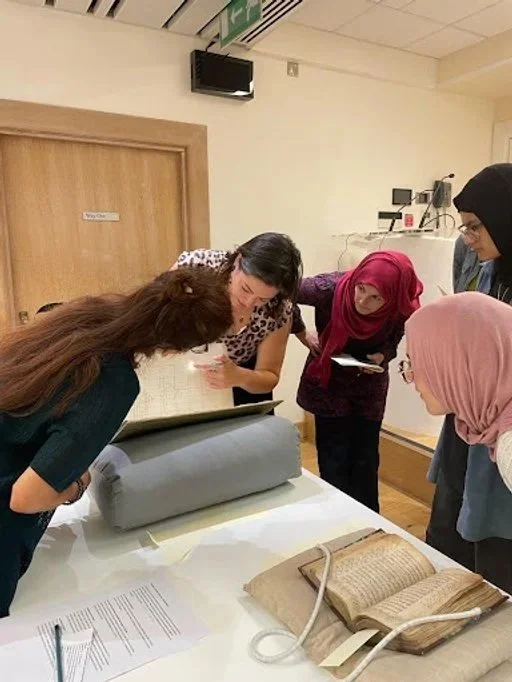
In our previous workshop, we looked at medicinal plants in scientific manuscripts, especially the works of Ibn Sina, Ibn Butlan, and Ibn Jazla. Many of the treatises on health and pharmacology included tables to classify and alphabetically organize the medicinal plants and their benefits—the books often labelled as Taqwīm (almanac; lit. rectification). The Taqwīm genre was not restricted to health manuals, and in this visit, we witness a copy of the Taqwīm al-Buldān (Almanac of Countries), a work on medieval geography that uses tabular forms to present the regions and countries of the world. The original copy was written in the 14th C by an Ayyubid prince and scholar, Abu’l Fida (d. 1331 CE).
This copy is undated, but upon further investigation using the Library catalogues and codicological tools, it becomes readily apparent that the manuscript is copied by a European hand, most likely Thomas Erpenius (d. 1624). Erpenius was a Dutch orientalist whose collection forms a large part of the University Library’s holdings related to Arabic and Persian materials. The manuscript also provided a great introduction into European paper vs. Islamic paper, the different moulds used for each, the polishing of paper in the Islamic world, and ways to distinguish them. We also discussed the circular table of contents.
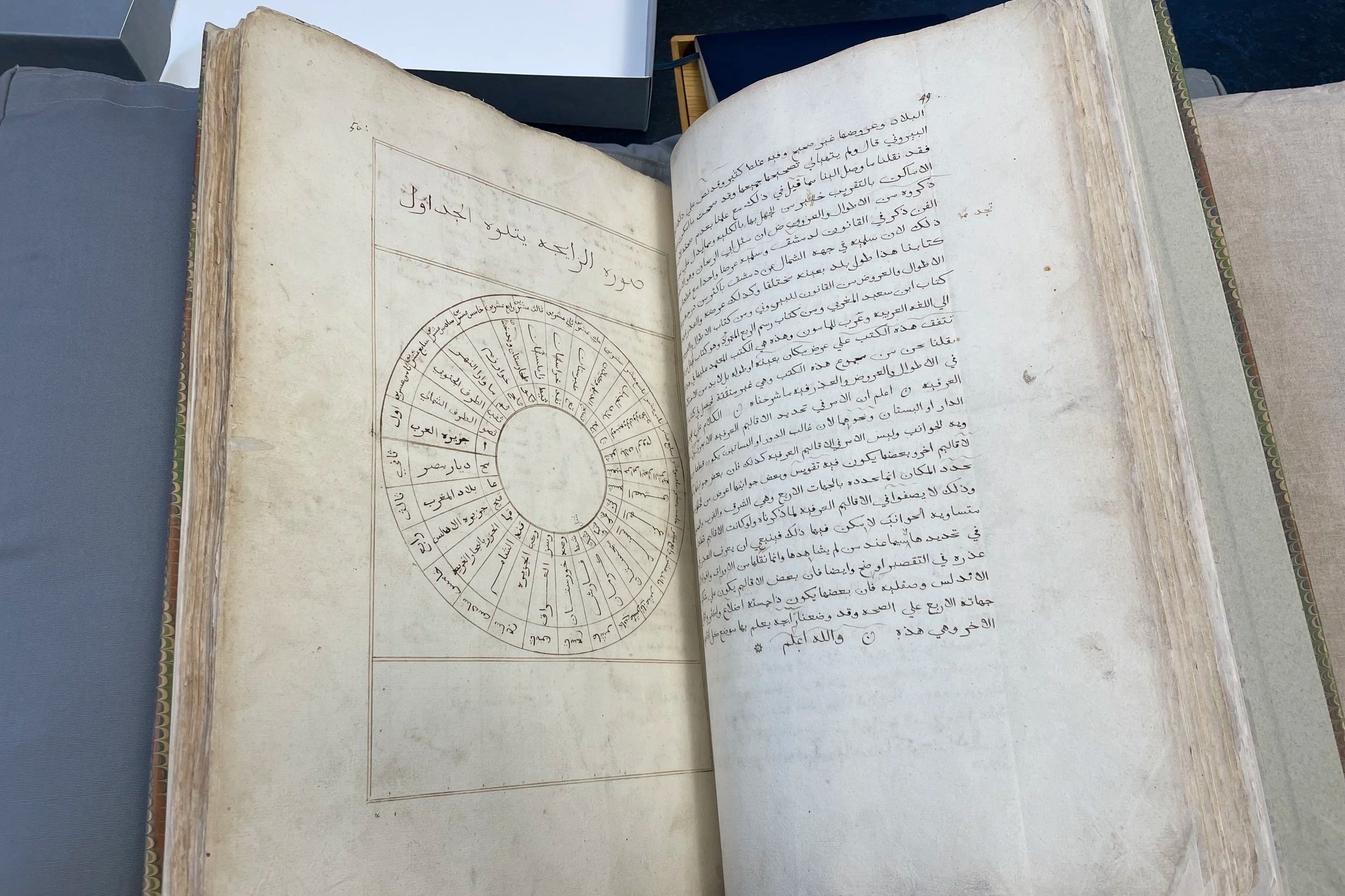
Above: Circular table of contents from Taqwīm al-Buldān, c. 17th C CE (Dd.1.2)
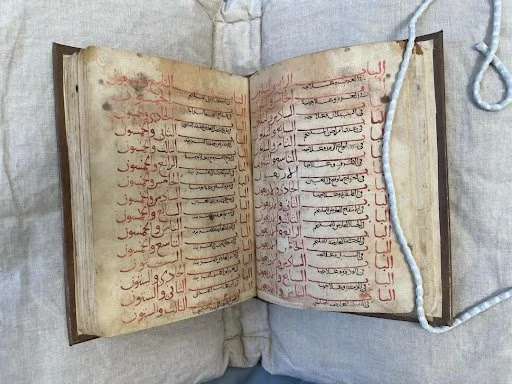
Table of contents of the Tadhkirāt al-Kaḥḥālin, c. 11th C CE (P.3)
We looked at a few other scientific manuscripts: an early 11th C Tadhkirāt al-Kaḥḥālin (Notebook of Oculists) and a 16th C commentary on medicine. One of the recurrent themes we encountered was the arrangement of information in ways that allowed for viewer accessibility and was pleasing to the eye. We noted for instance, the interchange of black and red ink, or the stretching of ligatures that carried both an aesthetic and a functional purpose. Another example was the 16th C tract on medicine with calligraphic writing in diagonal planes that not only divided the different kinds of information but was a work of beauty in itself. According to Rose-Beers, this manuscript used the very best kind of Islamic paper, and the participants noted the clean polishing on the folios.
We also had an opportunity to closely examine two illustrated manuscripts in Persian. The first was the Khamsa (Quintet) of Nizami Ganjavi (c. 1141–1209). The five poems in this work are: Makhzan al-Asrar (Book of Secrets), Khusraw va Shirin (Khusraw and Shirin), Layla va Majnun (Layla and Majnun), Haft Paykar (Seven Beauties), and Iskandarʹnamah (Book of Alexander). In addition to romances, his poems contain knowledge about philosophy, astronomy, and botany. Written in the masnavi form (rhyming couplets), the visual rendition of the poems on the page echoes this rhythm, with pairs of verses written on diagonal planes to form chevron patterns. The detailed and meticulous illustrations left us stunned. Kristine discussed some of the pigments (orpiment, verdigris) used in the treatise and the treatment of the paper with gold fleck. We also discussed the botanical patterns in the paintings, the prodigious cypress tree, and the blossoms.
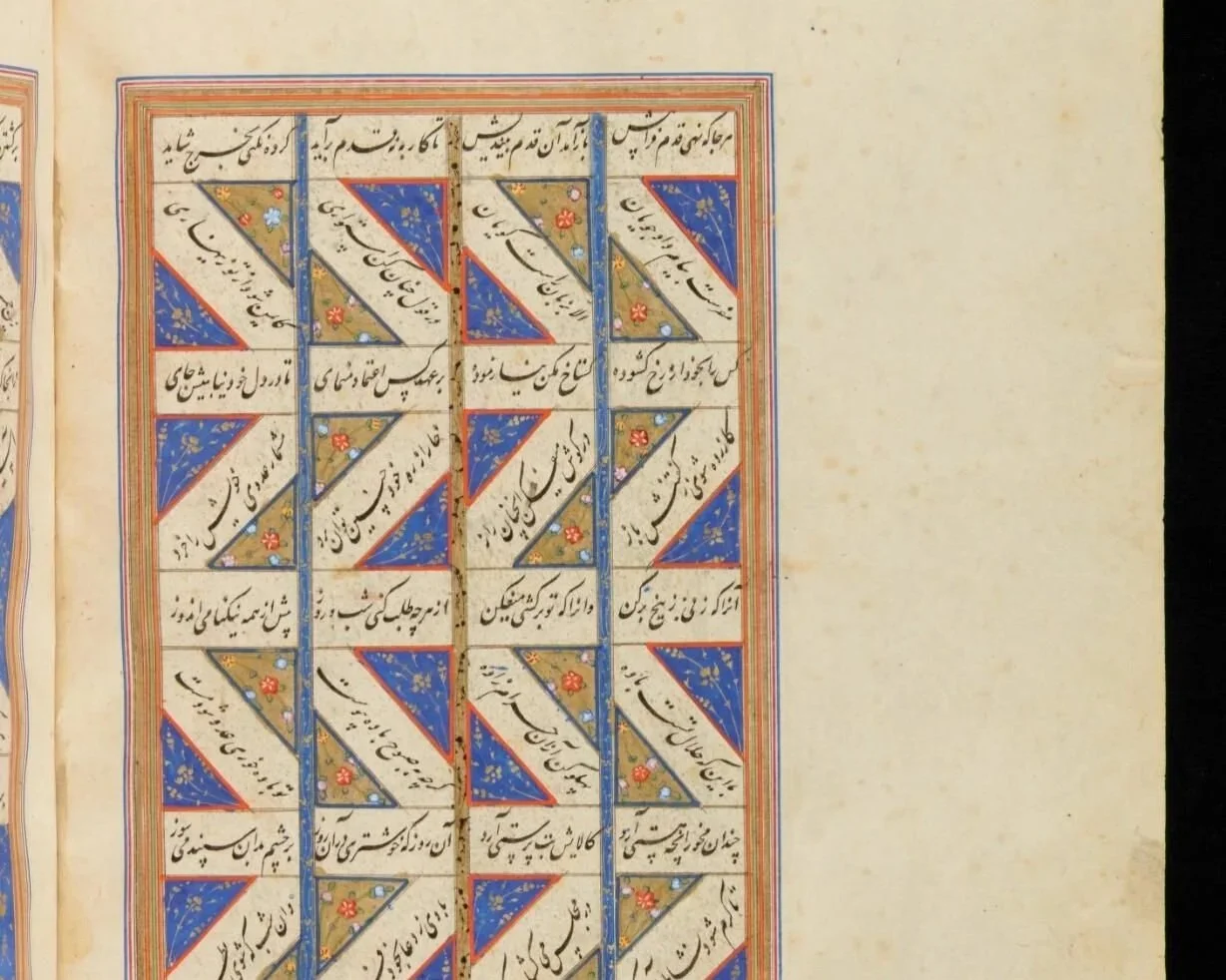
Khamsa of Nizami (MS Add 3139)
The botanical world is also discussed in the cosmographic treatise, ‘Ajā’ib al-makhluqāt(Wonders of Creation). Starting with the celestial world, the treatise devotes an entire section to the different plants in the terrestrial world—all with the goal of evoking wonder at God’s creation. We also looked at an early Arabic facsimile manuscript, the Maqāmāt of al-Hariri, and the central role of plants within the painted composition. Our final discussion was on the Latin copy (Tacuinum Sanitatis) of an Arabic health manual, the Taqwīm al-Siḥḥa (Almanac of Health) of Ibn Butlan (d. 1063). Over the course of our workshops, we have discussed the movement of Greek knowledge into Arabic, and in this example, we witness an Arabic manuscript and its translation into Latin. This manuscript was produced in northern Italy, at the end of the 14th C. While the original Arabic discussed medicinal plants without any illustrations, it was especially interesting to the note the abundant illustrations of plants in the Latin version.
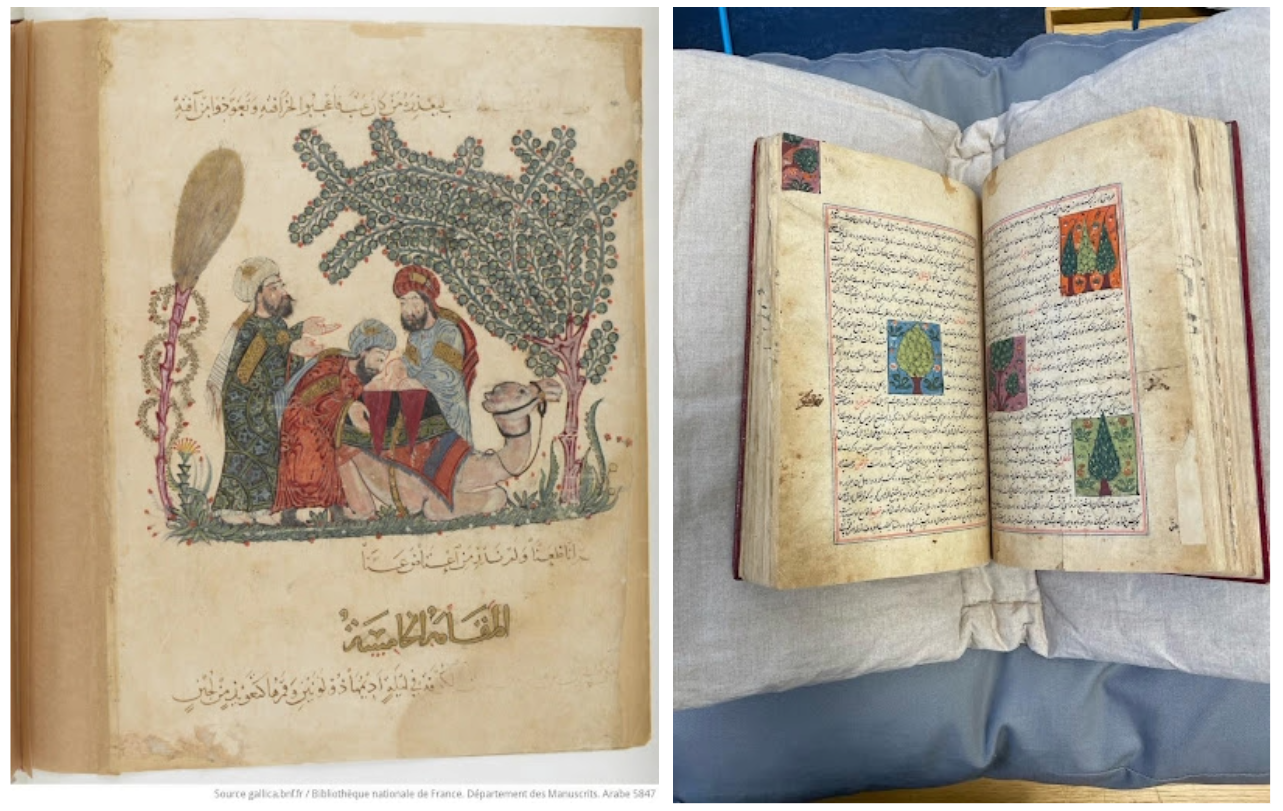
(Left) Painting from the Maqāmat of al-Hariri, 1237 CE, BnF arabe 2964
(Right) Plants in the ‘Ajā’ib al-makhluqāt (Or. 538)
Our session ended with a look at the plants in the dye garden, located in the north courtyard of the University Library. Kristine kindly walked us through the different plants, their properties, and the dyes and colours they produce. We looked at hollyhocks (that yield a purple-bluish color), chamomile (yellow), woad (dark blue color), safflower (red; peach), and madder (red-orange), amongst others. Observing the plants in their natural form was a fitting ending to this week, as we will be recreating some traditional dyes in our workshop next week.

Manuscript discussions with Yasmin Faghihi and Kristine Rose-Beers, Cambridge University Library