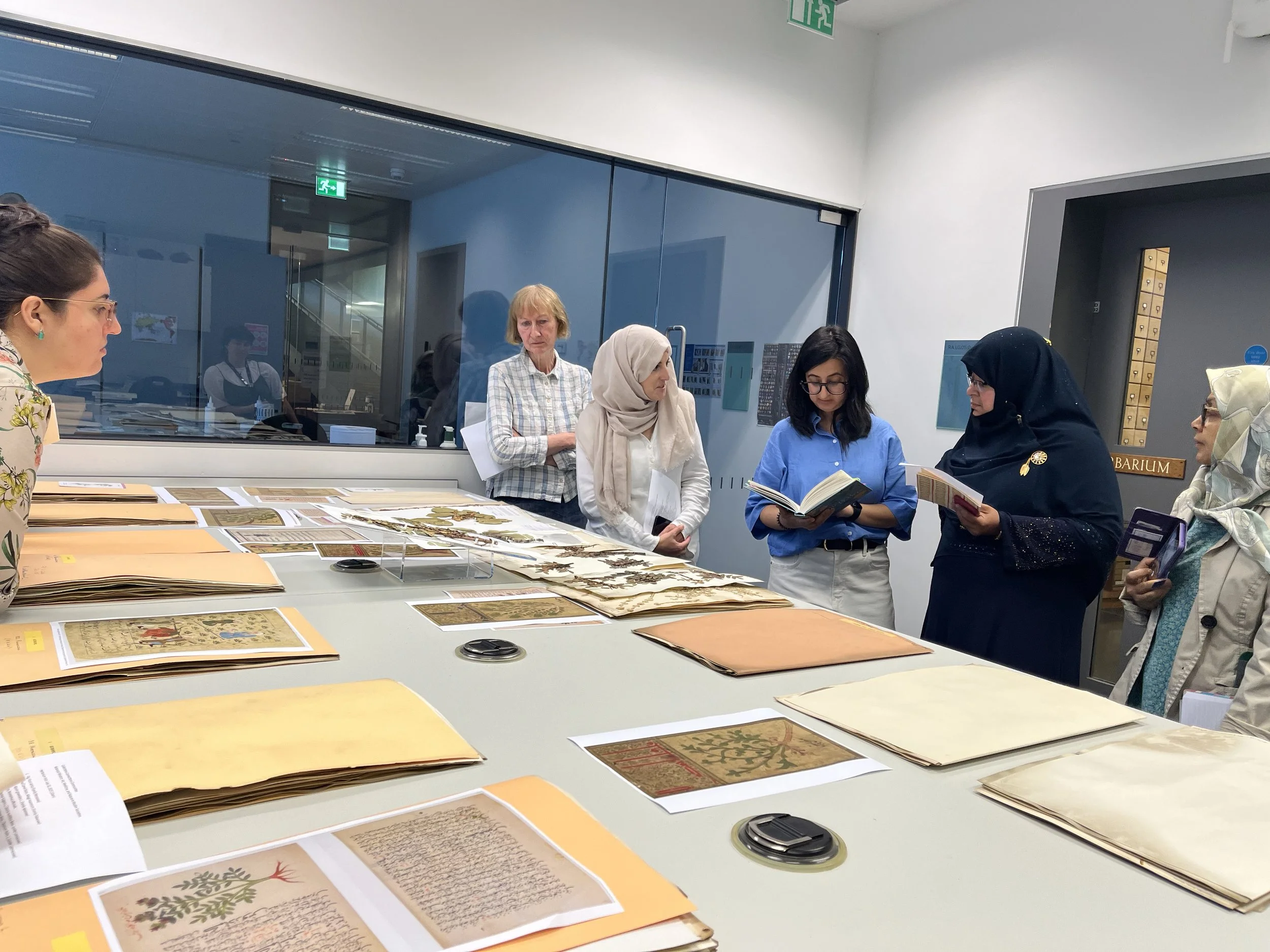
Herbarium workshop
Our visit to the Cambridge University Herbarium was quite special indeed. Juliet Anderson, collections assistant, introduced us to the history and holdings of the Herbarium. She also presented to us some of the oldest specimens in the collection, specimens related to Charles Darwin, and some pressed algae which captured our attention with its brilliant red tones.
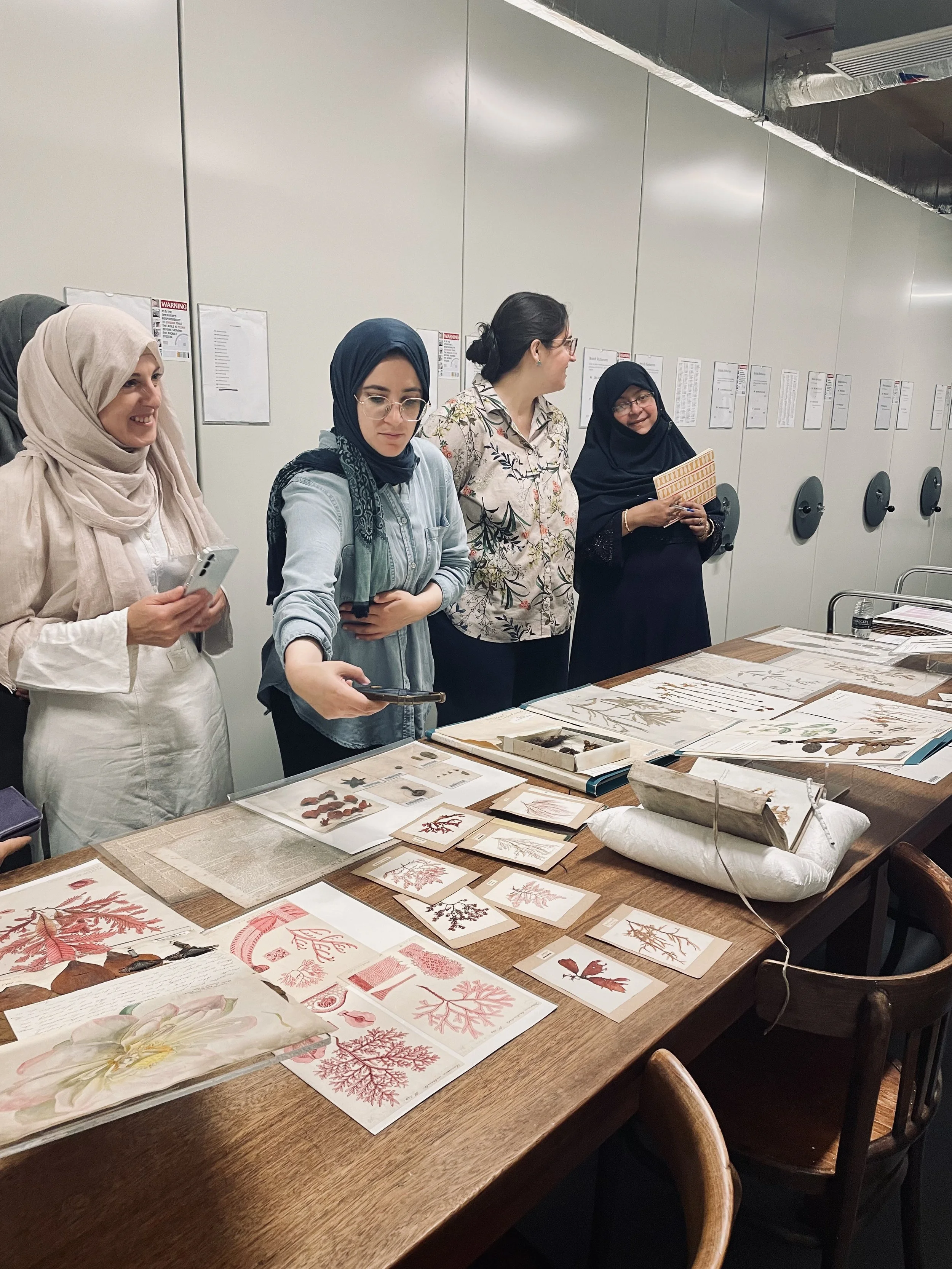
Participants at the Herbarium display led by Juliet Anderson.
For this workshop, I selected botanical specimens that we have seen in Arabic illustrated herbals between the 11th and 13th centuries, plants from the Qur’an, as well as bringing in specimens of personal interest to the participants. We kicked off our discussions with the mandrake plant (Mandragora officinarum), its medieval medicinal properties, and its centrality in the Greek and Arabic treatises of Dioscorides (De Materia Medica), the first-century Greek physician who compiled a book on plants and their medicinal uses. The fact that the mandrake was depicted as the plant mediating knowledge between Dioscorides and his pupils is significant: the plant, with human-like root, thus becomes the embodiment of knowledge and wisdom. This symbolic significance of the mandrake continues in the Arabic tradition.
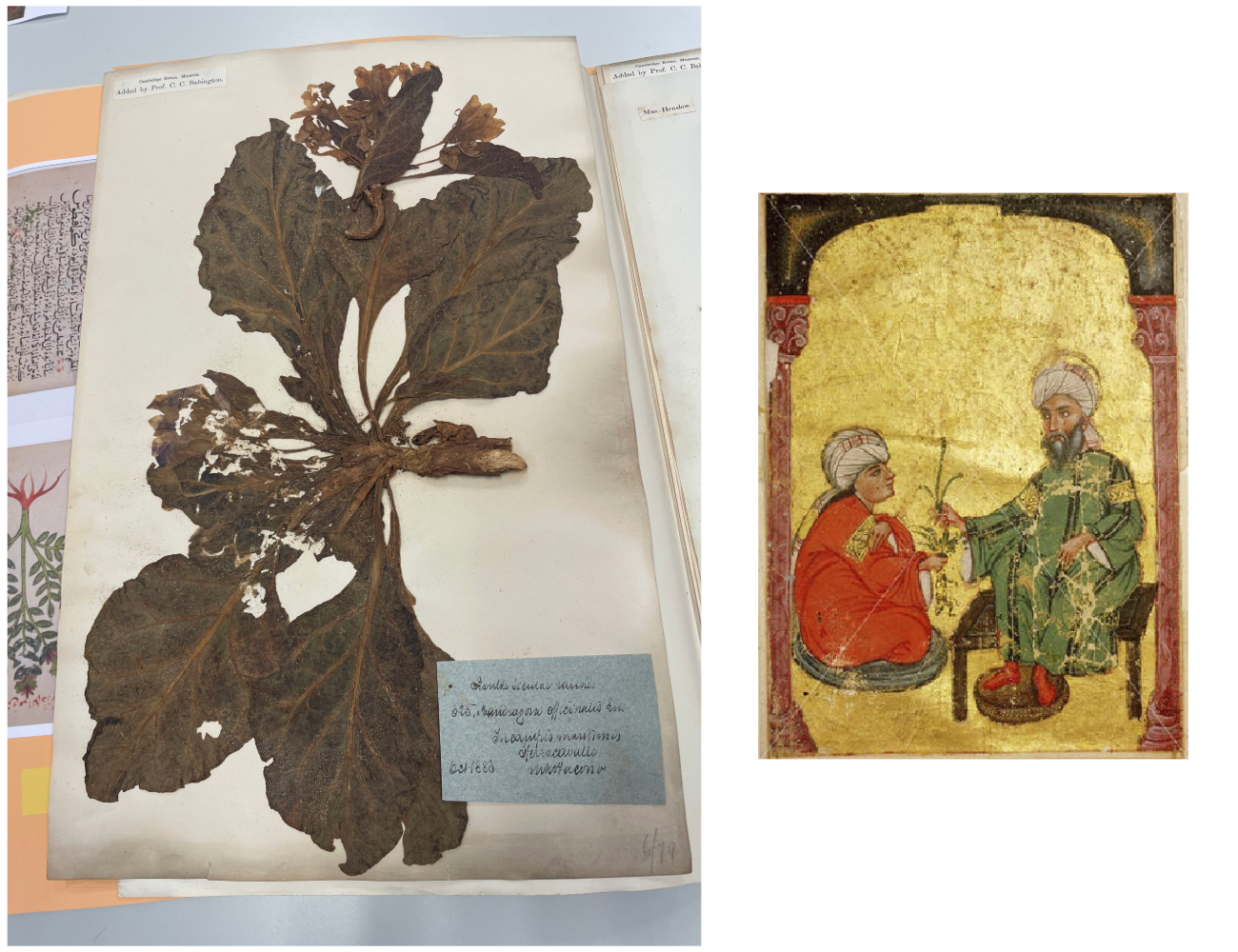
(Left) Mandrake specimen
(Right) Arabic treatise of Dioscorides illustrating the presentation of the mandrake plant, 626 AH/1229 CE, Topkapi Palace Library Ahmet III 2127
The fig plant (Arabic: tīn; Ficus carica) was a major highlight for us. Not only is it one of the plants of the Qur’an (and the Bible), many of the participants also have fig trees in their gardens here in Cambridge. We discussed the medicinal benefits of figs, its “hot” and “moist” properties as seen in humoral medicine, and its association with youthfulness and sanguine states. Figs also have a symbolic element in the Qur’an and the Hadith (sayings of the Prophet Muhammad) where the fig was understood to be the fruit of Paradise. While the medicinal and symbolic elements of the fig are often articulated as two sides of the same coin, one of the participants made a powerful connection between the two: the sanguine and youthful nature of the fig, in fact, makes it particularly suited to be the fruit that descends from Paradise.
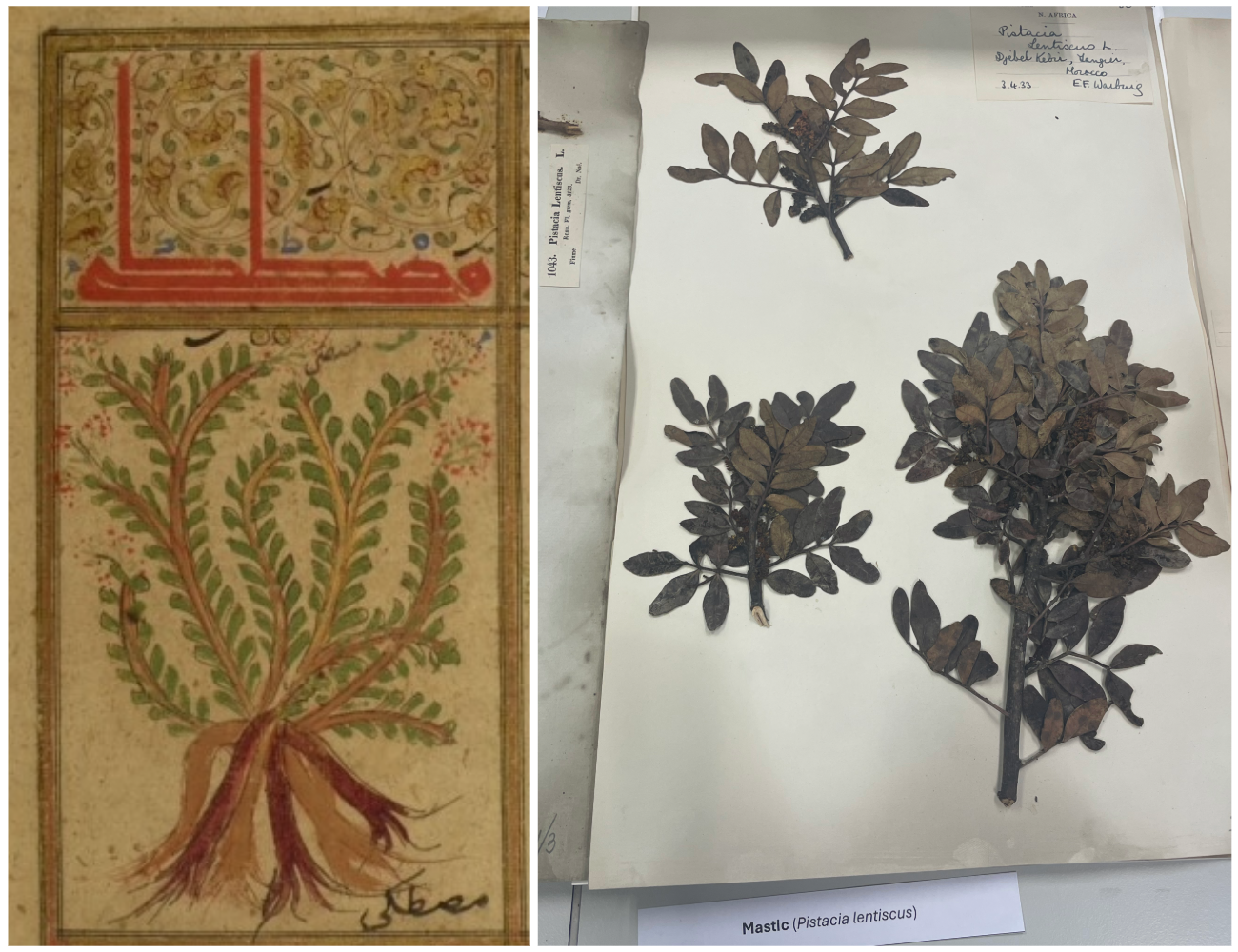
(Left)
Mastic specimen from Morocco
(Right) Mastic tree in the 12th C Kitāb al-diryāq (Book of Antidotes), BnF arabe 2964
It was wonderful to also see many plant specimens from regions of the Middle East and North Africa. For instance, we saw the mastic tree specimen (Arabic: maṣṭica; Pistacia lentiscus) from Morocco and Kyrgyzstan, comparing it to a twelfth-century illustration of the tree from an Arabic herbal. The medieval mastic tree was surprisingly accurate, with identifiable leaves and fruits.
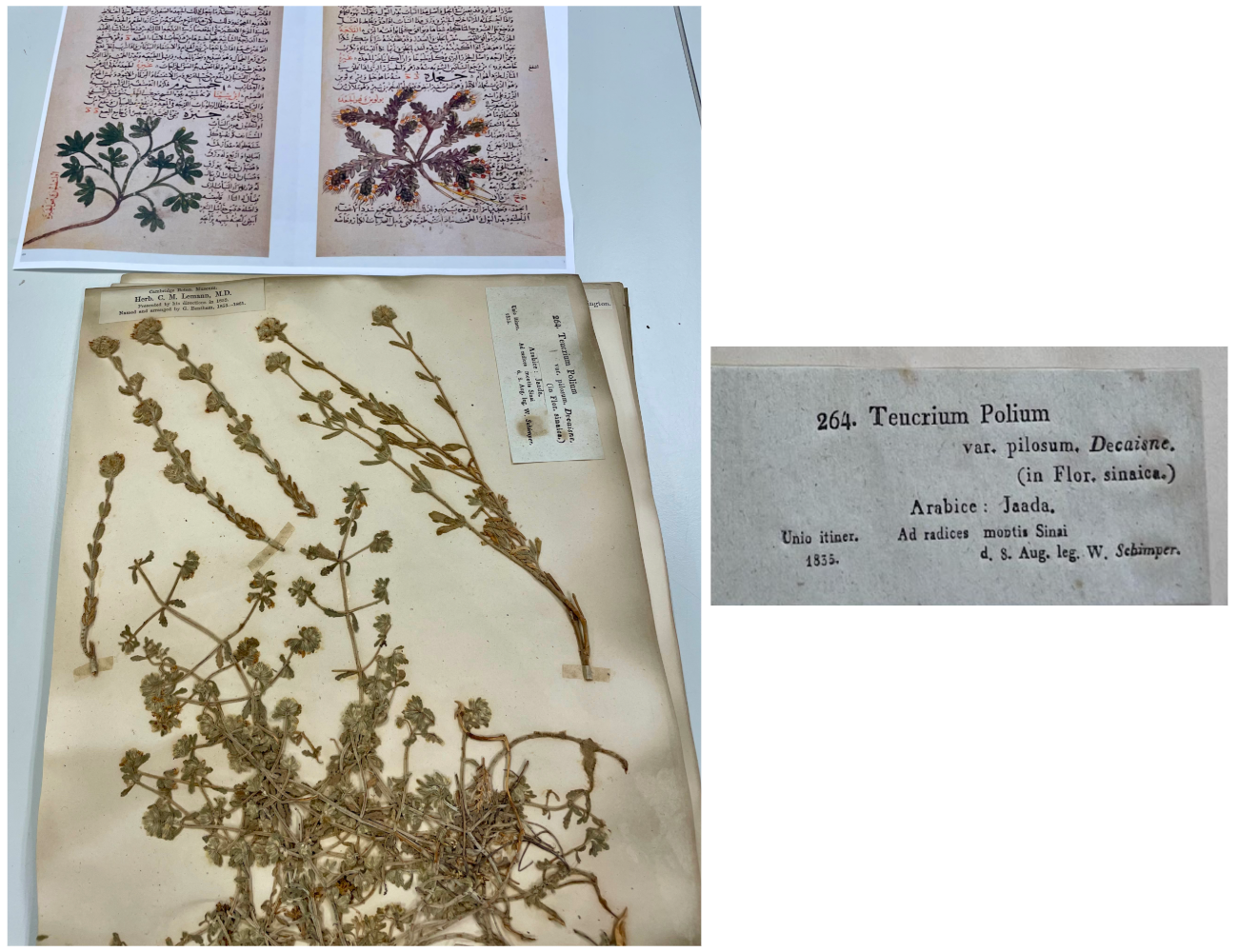
(Left) Germander specimen and its illustration in a 12th C Arabic herbal of al-Ghafiqi, McGill MS 7504
(folio on right above specimen).
(Right) Label for germander (Teucrium Polium) with the Arabic ja’ada.
There were also a few plants with Arabic names recorded as part of their original data, such as wild rue (Arabic: ḥarmal; Peganum harmala) collected from Algeria and Afghanistan; and germander (Arabic: ja’ada; Teucrium Polium) from the Sinai region. Interestingly, they were all collected by the German botanist, Andreas Schimper (1856–1901)—an avenue for future research!